Peer Review
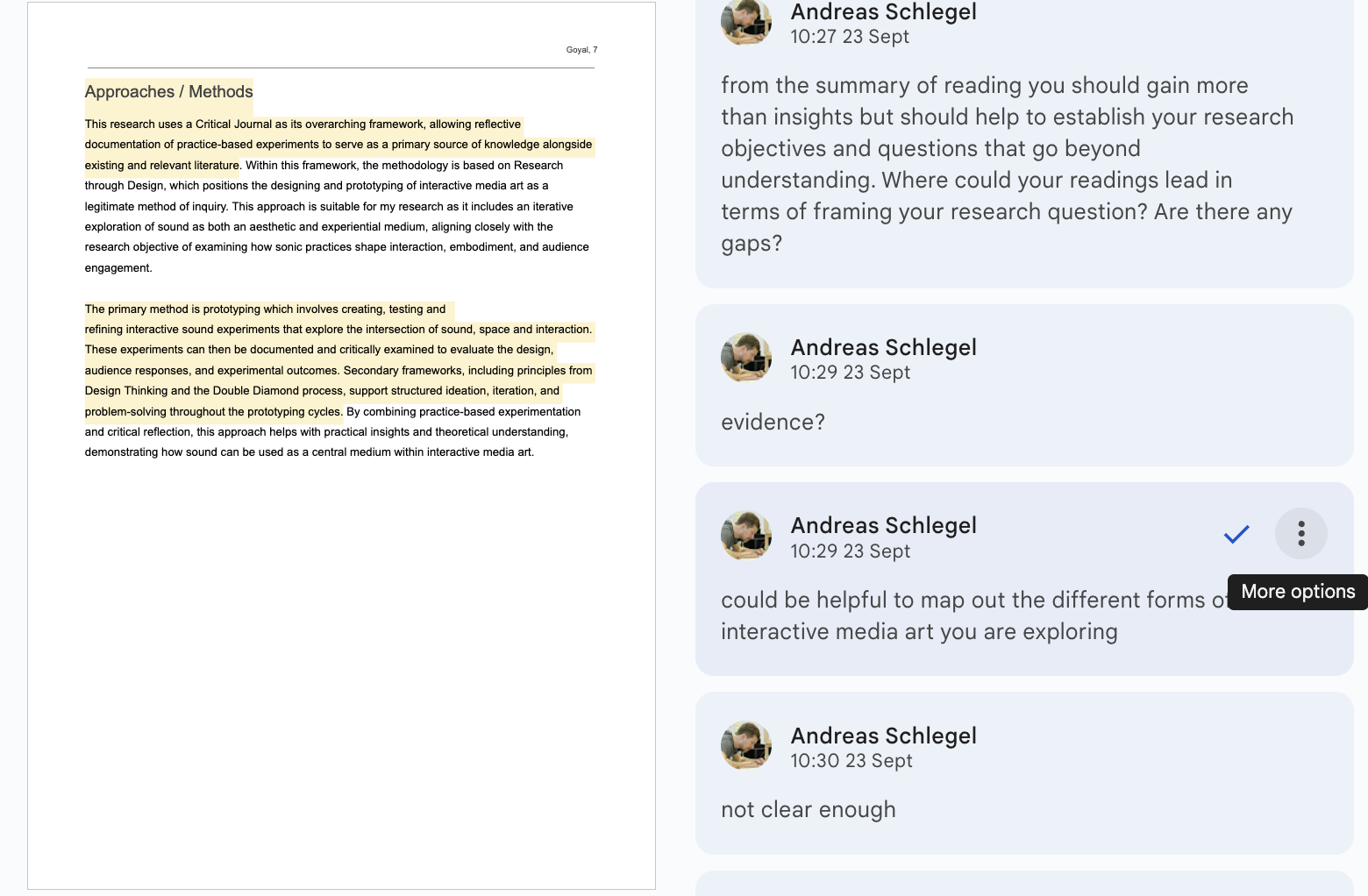
A week where I re-evaluated a lot. We had a peer review session as part of refining the RPO draft. All of us shared our drafts in class for feedback and see what they feel. The feedback was divided into 4 different parts where we share what we like, dont understand, what works well and what can be considered.
-
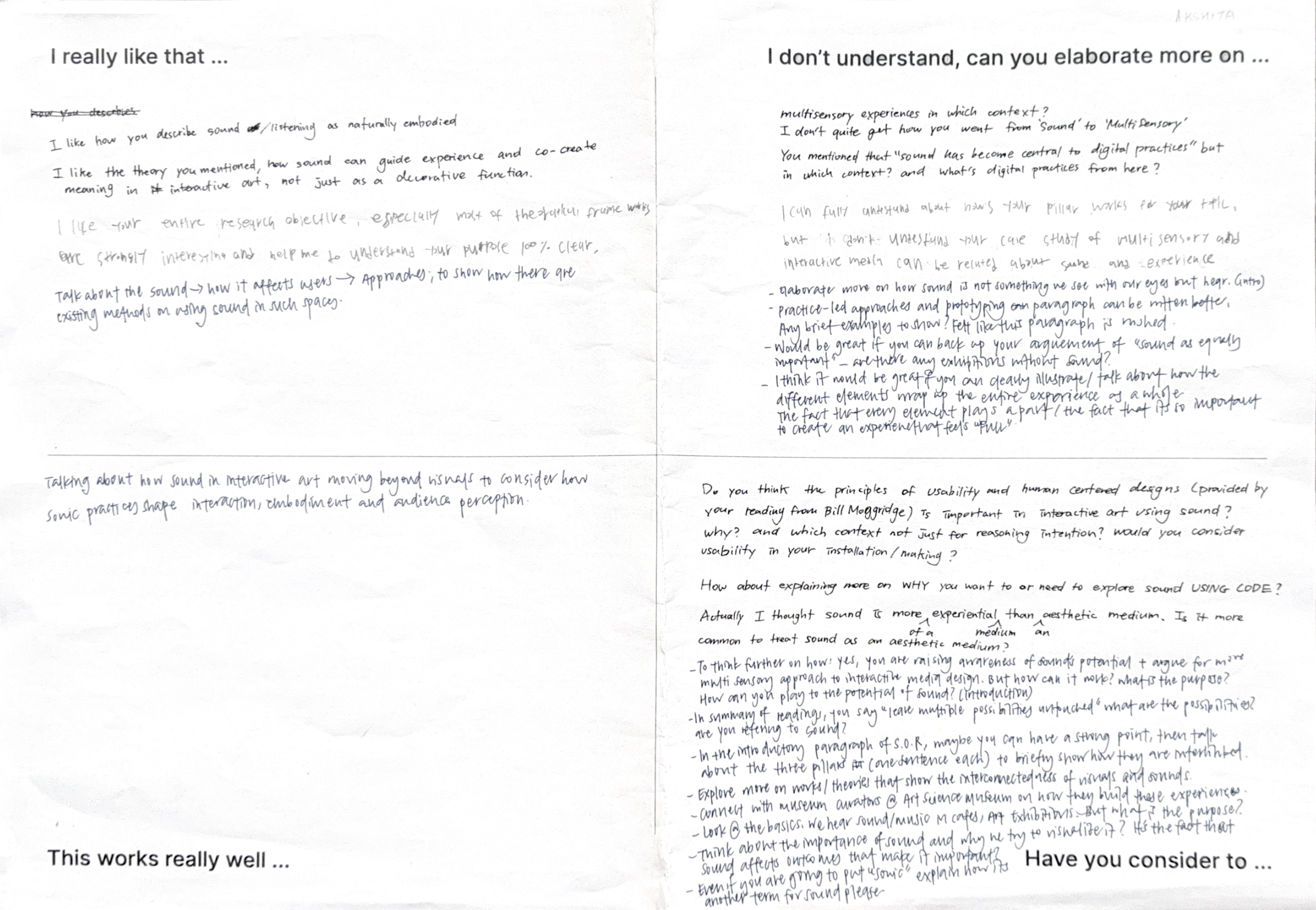
Feedback given to me: side 1 -
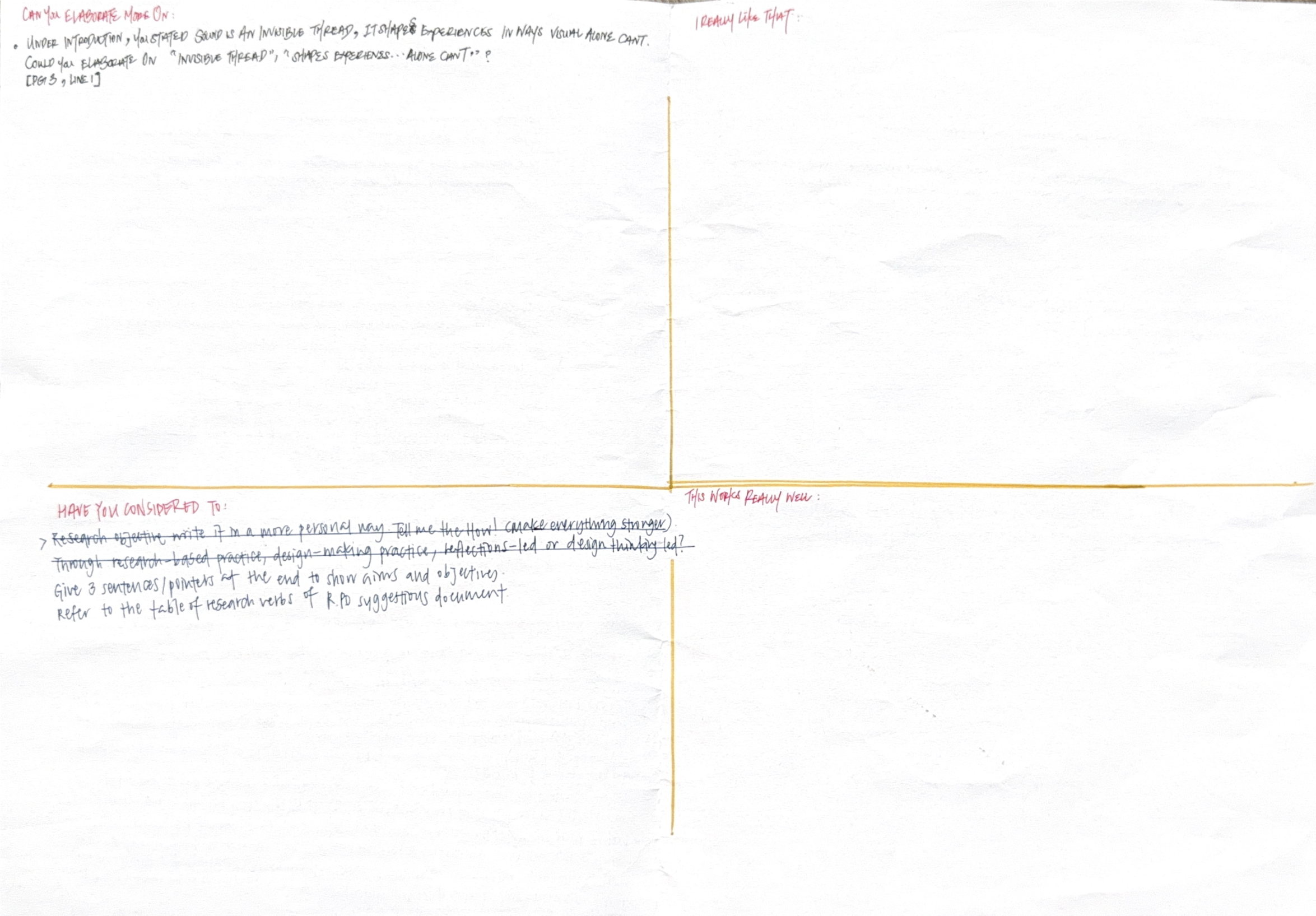
Feedback given to me: side 2
It was not easy to read so much so early in the morning and give feedback but it was really important because I was able to learn a lot from this. Everybody in class had different writing styles and they were all very clear about defining certain things they mentioned which made it more comprehensivve and easy to read. There was a lot of think about after this peer review. I realised how my topic was not very clear to the people who were reading the paper. There are things that I have been reading for a while hence they are clear to me but I need to work on explaining them using examples and just overall structure better.
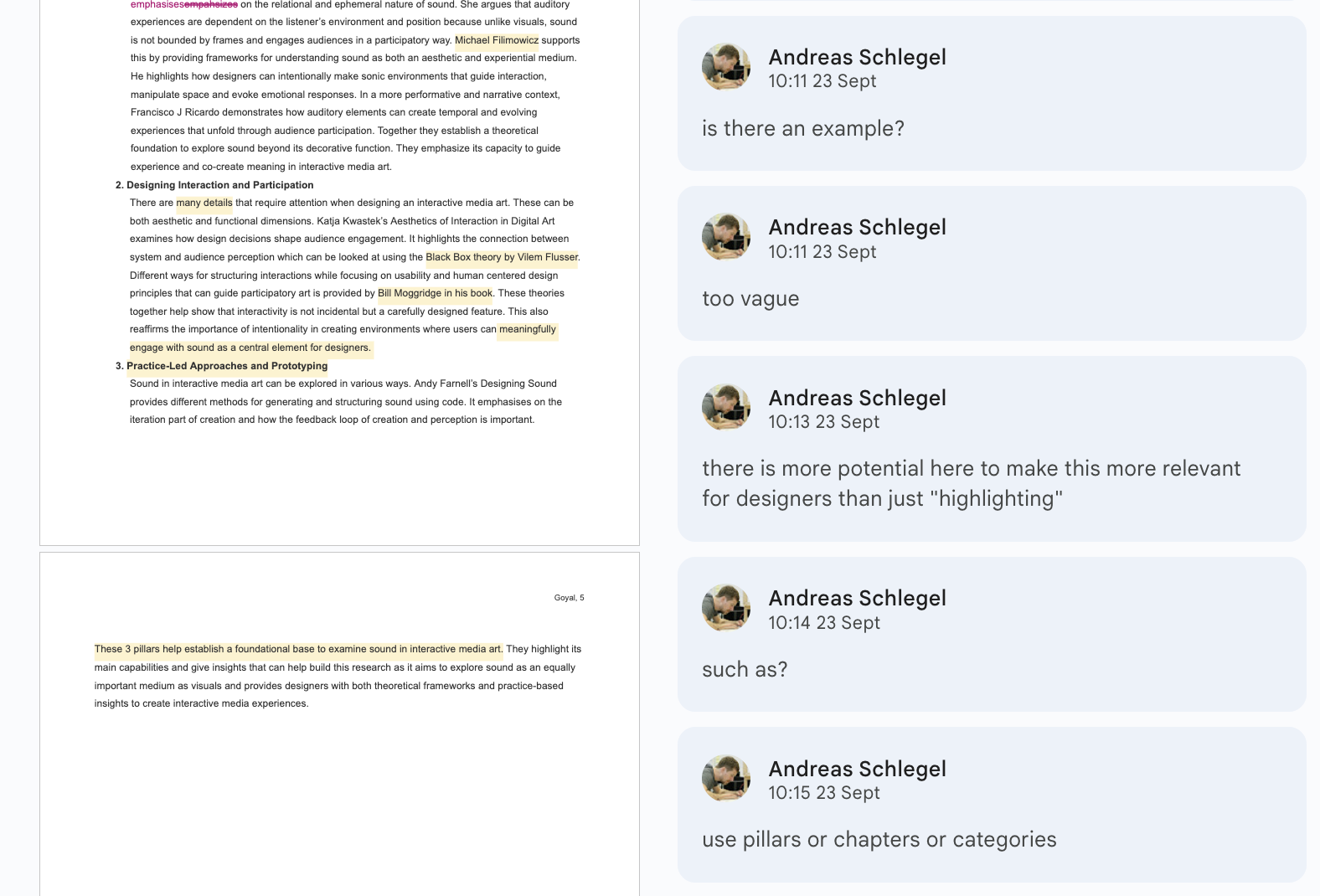
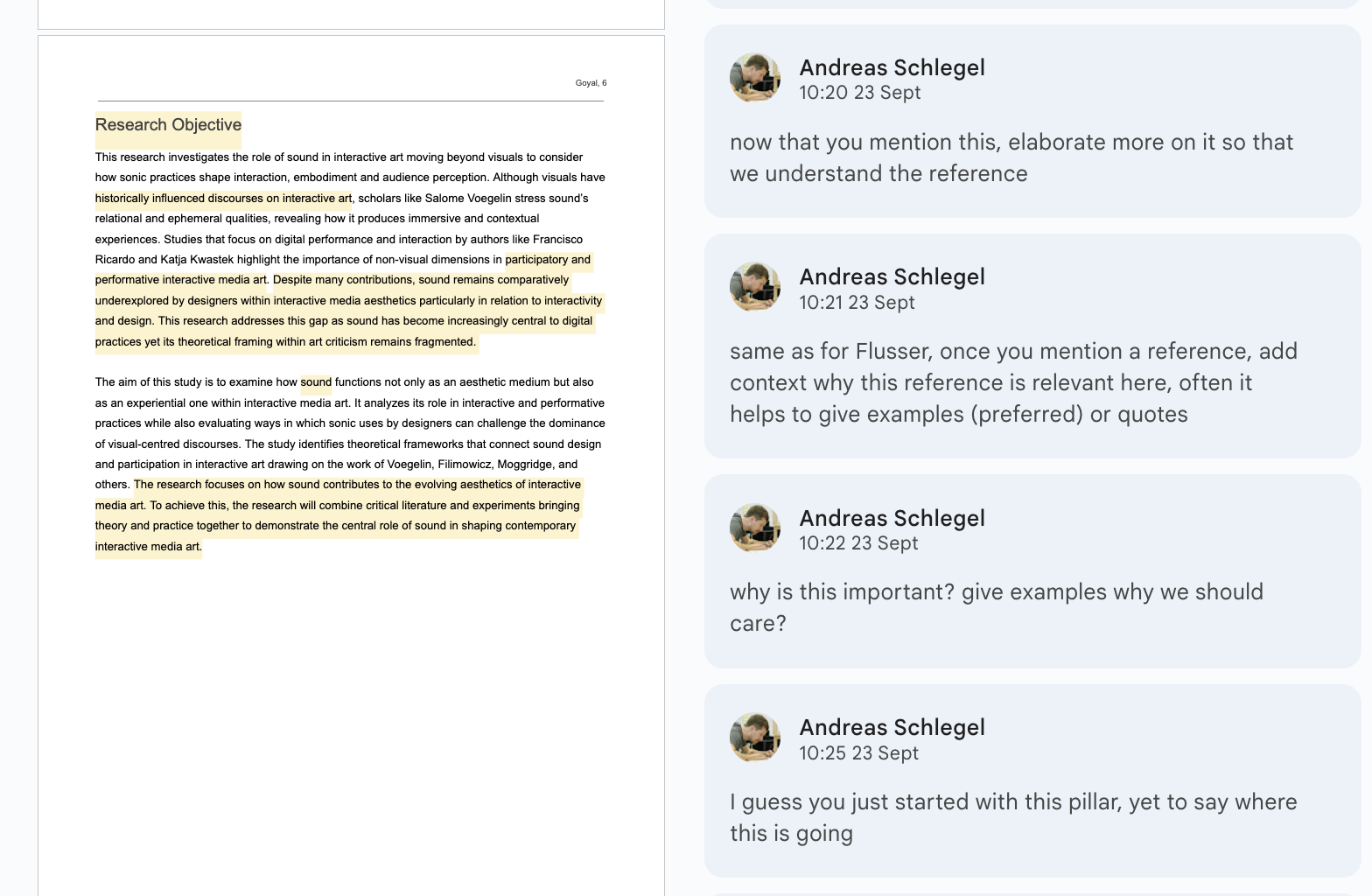
I also received feedback from Andreas at the same time which also pointed towards similar thiings my classmates did and I noticed when I was reading their papers. He also mentioned how it missed being achnored in Interactive Media Arts well and how it often missed the mark since it was vague and not well referenced. I worked on these parts after reading some other papers that he recommended me to so I can understand how professionals write them.
Exploring Sound Based Works
After the peer review I felt like I needed to look at more sound focused work in IMA to
understand how artists treat sound as the centre of the interaction. Reading everyone’s drafts made me
realise that I was writing about sound but not really showing how I was connecting it to actual practices. So
I decided to spend time looking at a few smaller and more experimental sound projects that could help me think about
sound in a clearer way. These works are quite simple compared to big installations but they opened up new ways of thinking about
how sound behaves inside a system and how I could approach my own tests.
Listening Machines by Timo Kahlen
I came across Listening Machines by Timo Kahlen while searching for interactive sound work that is not fully digital.
In these works he uses small physical materials like air, dust and tiny motors to generate sound directly from movement.
The machines are set up in a way where the sound is not recorded or fixed. It changes depending on how the environment behaves.
Even very small movements can shift the tone or create sudden textures. I found this idea of the system producing its own sound
without direct human control very interesting. It made the work feel alive.
-
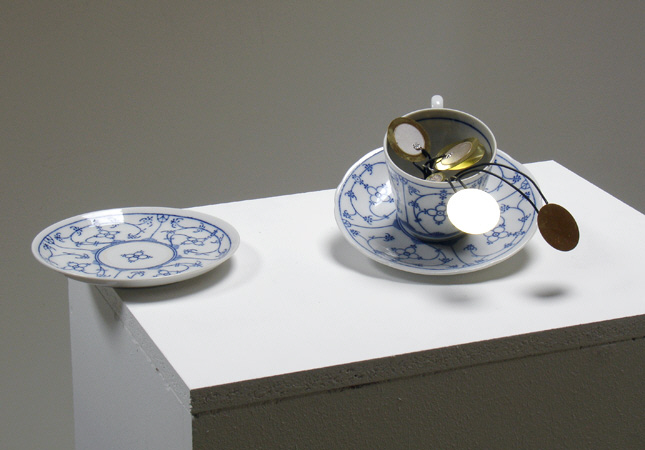
Infusion, 2010
Minimal sounds created by the slight vibration of several small piezo loudspeakers against the porcellaine rim of a tea-cup. A very instable setup (Artist website) -
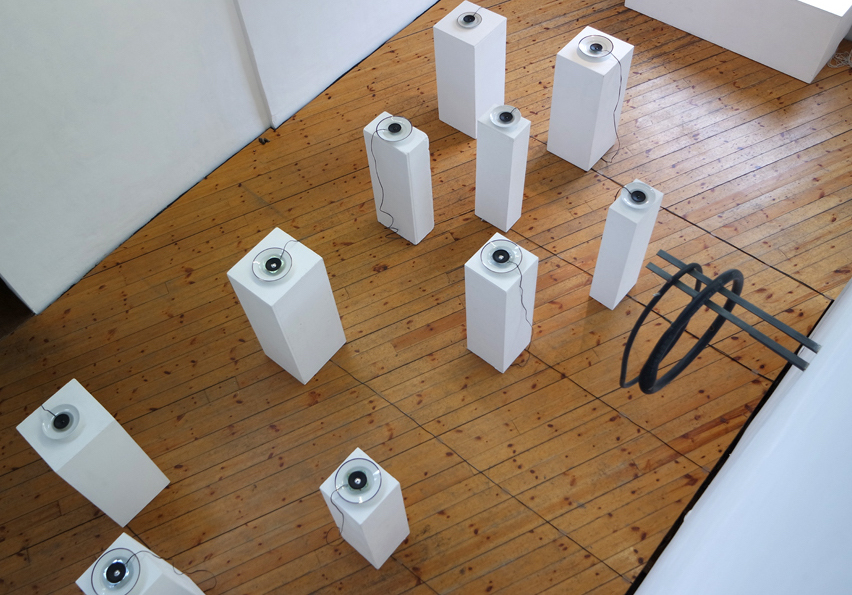
URSUPPE, 1987 - 2019
Eleven pedestals presenting an archive of selected field recordings of technological and natural sounds from the artist's archive. (Artist website)
What stood out to me was how fragile the sound was. Sometimes it is steady and sometimes it becomes unstable. This made me think of sound as something that can fluctuate naturally instead of being clean and predictable. I realised that a system can feel interactive even when a person is not touching it. Sound can respond to tiny environment changes or the behaviour of the material itself.
This influenced my thinking because I started imagining small sketches where the microphone input reacts not only to loud sounds but to more subtle changes. Maybe the visual can shift slowly when the room is quiet and more dramatically when something sudden happens. I liked the idea of building something that listens in a softer way rather than responding only to obvious triggers. It made me want to try experiments that allow the system to behave with a bit of its own personality.
Patatap by Jono Brandel
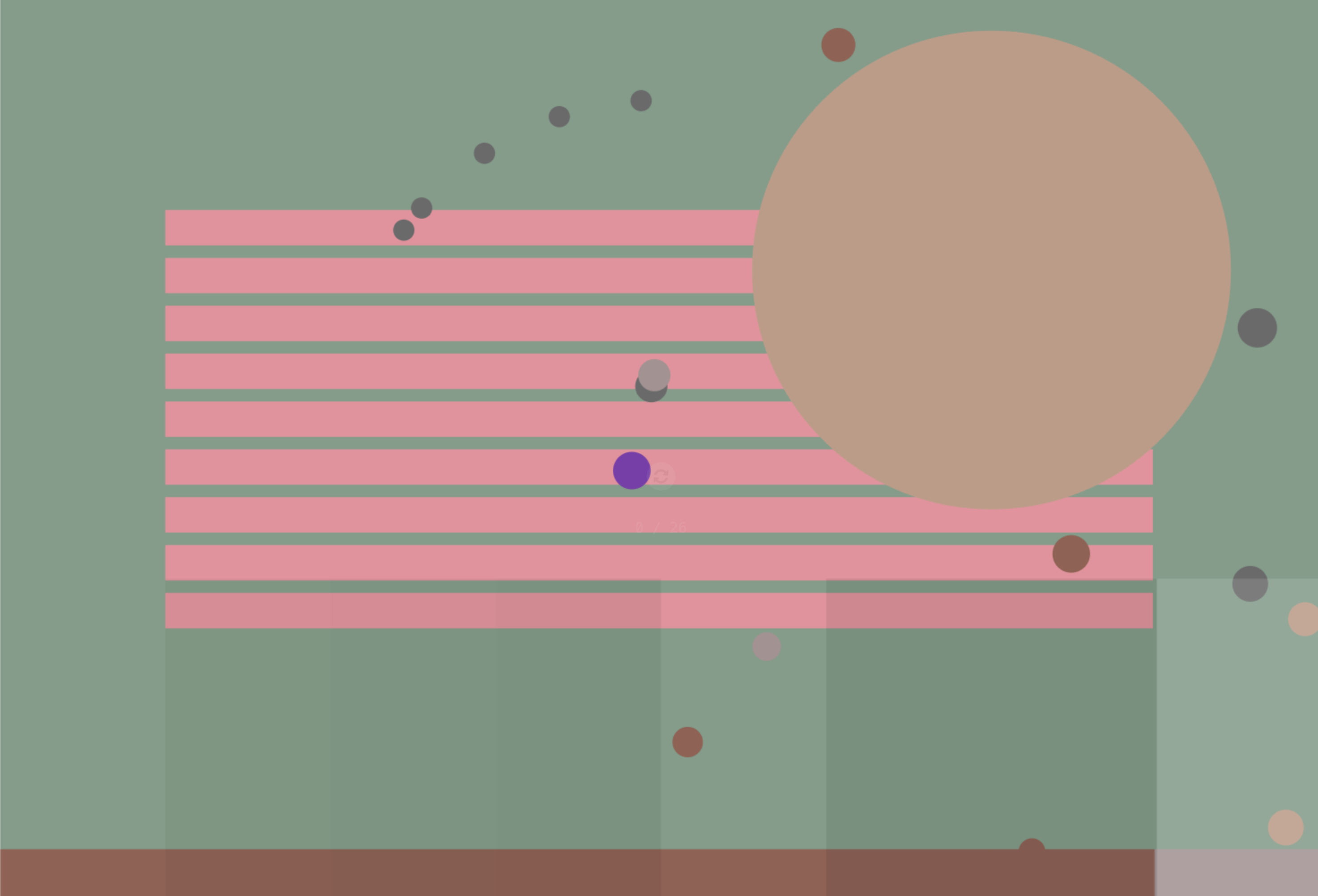
While searching for small sound based prototypes I revisited Patatap by Jono Brandel. It is a very simple site where each key on the keyboard triggers a small animated shape and a short sound. There is nothing complicated about it but it feels very complete. The whole interaction depends on timing, colour and rhythm. It reminded me of how simple sound tools can still feel interactive and expressive when the mapping is done clearly.
-
-
-
An example on how we could create a composition on it.
What interested me was how clean the experience is. The sound is not overloaded with effects. The visuals are tiny animations that disappear quickly. But together they feel playful and satisfying. It also showed me how important it is to have a stable and immediate response when creating sound interactions. Even though the project is small, the timing of the audio makes everything feel more immersive.
This influenced my direction because it made me want to simplify my own ideas. Instead of building something large, I realised that even a basic keyboard to sound sketch can help me understand timing and behaviour. It also connects back to the alphabet experiment I made earlier. Seeing Patatap made me want to try a more refined version of that idea where the letters have clearer sound personalities and maybe even small visual reactions.
Wrapping Up
These works helped me reset after the peer review and gave me a clearer sense of how to approach sound in IMA. For next week I want to test one simple sound interaction sketch. My goal is to understand the behaviour of sound more deeply and to keep the process slow and real. I also want to continue improving my writing so the RPO becomes clearer and more grounded in real examples.