Workshops and Techniques
CRITICAL JOURNAL SEMINAR
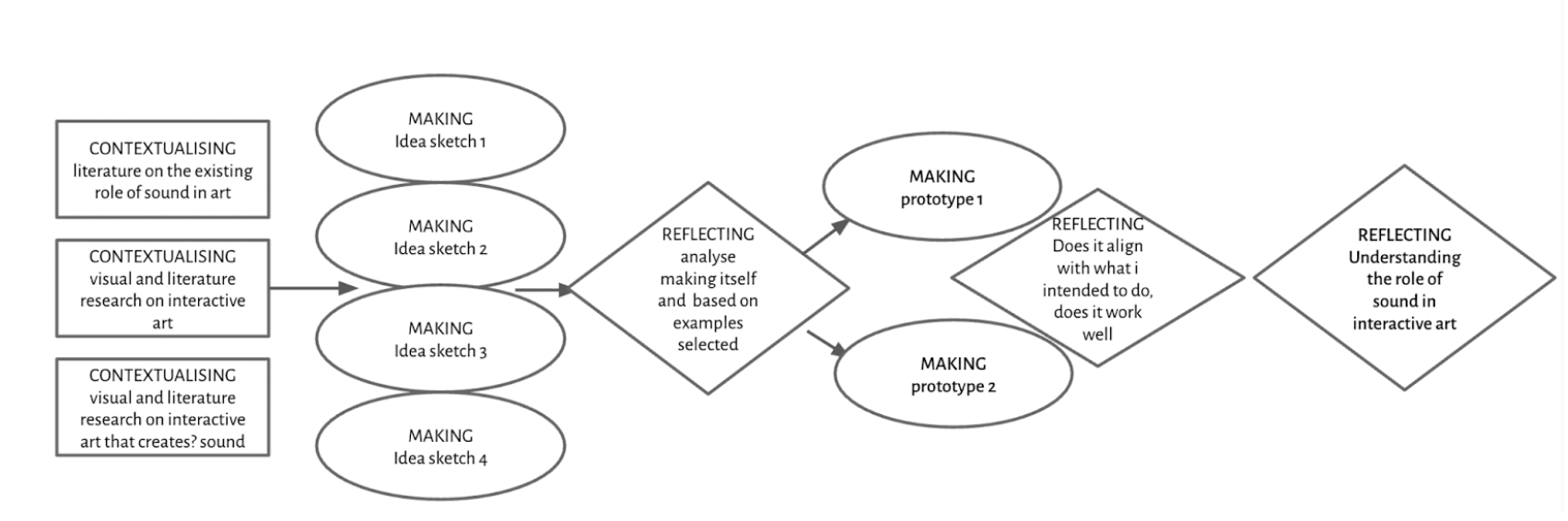
This week focused on understanding the framework OF a critical journal. A
critical journal is not simply a diary of events but a structured and iterative document that connects theory,
practice, and reflection. It develops around one’s own creative practice, bringing in external references and contextual
knowledge to build a more informed perspective. The seminar by Shumin emphasized that critical journal operates in an ongoing cycle
where thinking and making continuously influence one another through observation, analysis, and refinement.
The core takeaway was that a critical journal functions as both a research process and a reflective practice, allowing us to
connect practical experimentation with theoretical grounding. This understanding helped me see how documenting my process, from sketches
and code experiments to reflective writing , contributes to forming new knowledge rather than just recording outcomes.
This contrasts with research methods like interviews or case studies, because the researcher often remains distant from the subject.
I found it perfectly relevant to my own project, as much of my exploration with sound and interaction depends on experimentation and iteration.
When I test new ways of translating sound into visual form or when I connect sensors to generate responsive outputs, these actions themselves serve as a method of discovery.
Contextualising Practice
A key part of the research is situating one’s work within broader contexts social, cultural, aesthetic, and technical.
We were reminded that anything influencing our creative process must be cited and critically reflected upon. This encourages
a conscious awareness of the artistic, cultural, and theoretical ecosystems that inform our practice.
For me, contextualisation means positioning my exploration of sound and interactivity in a space inspired by artists and theorists who have
examined similar concerns, such as David Rokeby, Janet Cardiff, and Jonathan Sterne or even the many design authors. Their works help me understand
where my project sits within the ongoing discourse of sound as a participatory and emotional medium in new media art.
Thinking and Making
One of the main ideas from this week’s seminar was the relationship between thinking and making. They are not separate
stages but interdependent activities that shape each other. Donald Schön’s model of reflective practice was introduced as a
useful way to understand this relationship:
Reflection-in-action refers to the thought that happens during the act of making, the instinctive decisions, adjustments, and improvisations that emerge as part of the creative process.
Reflection-on-action occurs after the making when we step back to analyze what worked, what didn’t, and what meaning the outcome holds.
Applying this to my own process, when I’m coding a sound-reactive sketch or assembling an Arduino, reflection-in-action happens naturally.
However, the act of documenting, reviewing, and analyzing these experiments later forms reflection-on-action. Both are essential for developing a deeper understanding of my creative inquiry.
Mind-Map Exercise
In class we did a mind-map workshop where we all came up with our mind maps and went around looking at others after. When we liked an idea we would put a sticker near it
so the person could think if they wanna elaborate on that thought. A lot of people like the idea of sound as a mood and influencing memory in my mind map. It was interesting because
for me the idea of real time interaction in sound was more interesting since I could explore a lot. It was also at this moment I realised maybe I was looking at the entuire project from more of
a making lens than a research so I decided to take a step back and see what I part of research in this topic I liked more. Hence, I went home and made another version of it to undserstand my thoughts better
and also where I was at durin gmy research.
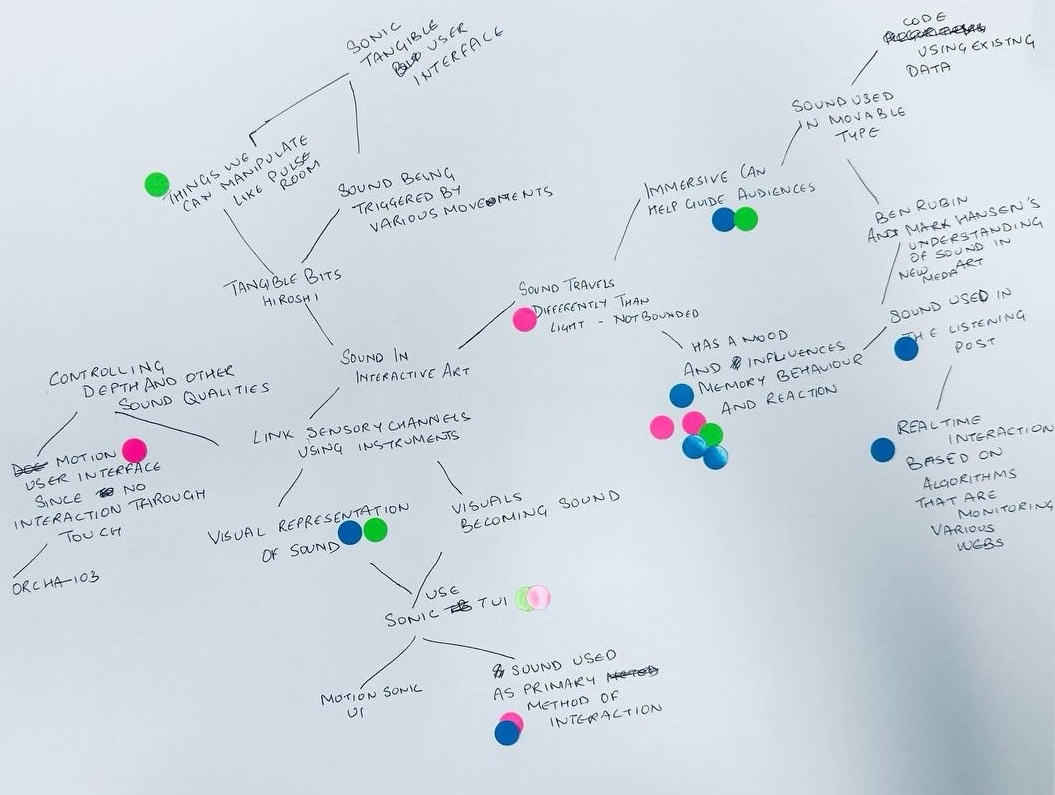
Mind Map made in class
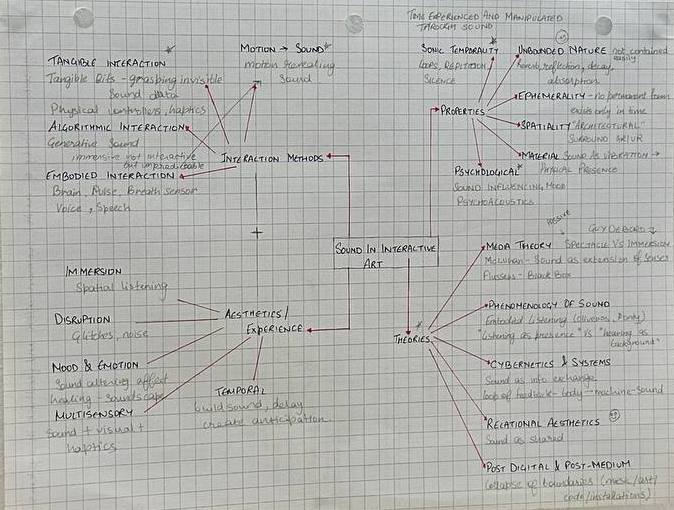
Mind map after class.
Experiment 01
I was very interested in exploring sound as an input for interaction. My project direction was
anchored in “sound in interactive art,” and I was focusing on how audio frequencies could shape motion,
patterns, and behaviour on screen. This first sketch I built was essentially a sound-reactive visual system using
p5.js. Microphone input fed into FFT() analysis, and based on energy across bass, mid, and treble bands, different visual “modes” reacted accordingly.
I created three modes:
DNA Helix : spiralling dots stretching and tightening based on mid and bass
Neural Network : nodes drifting around and connecting depending on sound energy
Wave Wander: long flowing waveforms distorted by higher frequencies
There were also background elements: floating particles, shifting grid lines, and a scanline moving across the canvas. It wasn’t conceptual;
it was exploratory and a way to understand what sound does when you give it something to manipulate.
What I Observed
Even though I didn’t have a clear framework at that point, a few things became apparent:
(i) Different frequencies carry different emotional textures.
(ii) Bass expanded and pushed visuals outward; treble made things jittery.
(iii) Movement patterns can feel bodily, even without meaning to.
(iv) The neural nodes pulsed like a circulatory system; the helix felt anatomical; the waves resembled breathing.
I didn't intend this, but my sketch naturally drifted toward biological metaphors.
Sound as “behaviour” instead of decoration.
This was the first time I realised visuals shouldn’t only bounce or scale, they should behave differently depending on sonic qualities. This changed the way I approached interaction in later weeks.
The system only reacted once audio input was activated, and even whisper-level sounds created tiny shifts. This experiment made one thing clear:
sound influences motion in ways that feel physical, almost tactile.
Even though this sketch is not a final outcome or even the best looking, it helped train me to look for:
patterns
behaviours
vibrations
responsiveness
(all of which eventually became central when I shifted to sound–haptic relationships.)
Moving Forward
By the end of Week 3, I developed a clearer understanding of what a critical journal aims to achieve not just reflection, but connection.
The seminar has helped me see my work as part of a larger universe of inquiry, where every act of making is also an act of research.
I want to deepen my reflective writing practice by linking theory and making more experiments with more knowledge.
Begin connecting my old sound experiments to contextual references and critical readings.
Use iteration and peer feedback as structured tools for refinement.
Another significant learning point this week was the importance of iteration, not expecting the first idea to succeed,
but seeing every version as part of a bigger picture. Through feedback and testing, ideas evolve. I found the idea of
“giving each idea three minutes” useful, testing whether an idea holds enough interest and depth to continue.
am beginning to see how iterative testing in my coding process mirrors this mindset. Each failed prototype, each glitch or unexpected sound output, offers information about where to go next.
This week’s learning reinforced that practice-based research is not only about
producing outcomes but about generating understanding through doing, reflecting, and articulating. My challenge now is to make and connect my technical experiments
with sound and interaction into a reflective framework that captures both process and meaning.