Prototypes and Beyond
This week felt like the last stretch before everything is due, and I went in wanting to push the second prototype as far as I possibly could.
I knew I didn’t have much time left, but I still wanted to at least get the full interaction loop working : touch, motor, sound, and eventually visuals.
It was also a week where all the technical problems I had been avoiding or postponing suddenly showed up at once.
I officially did my best to work on the second prototype as much as time permitted, but I ran into far more issues than I expected.
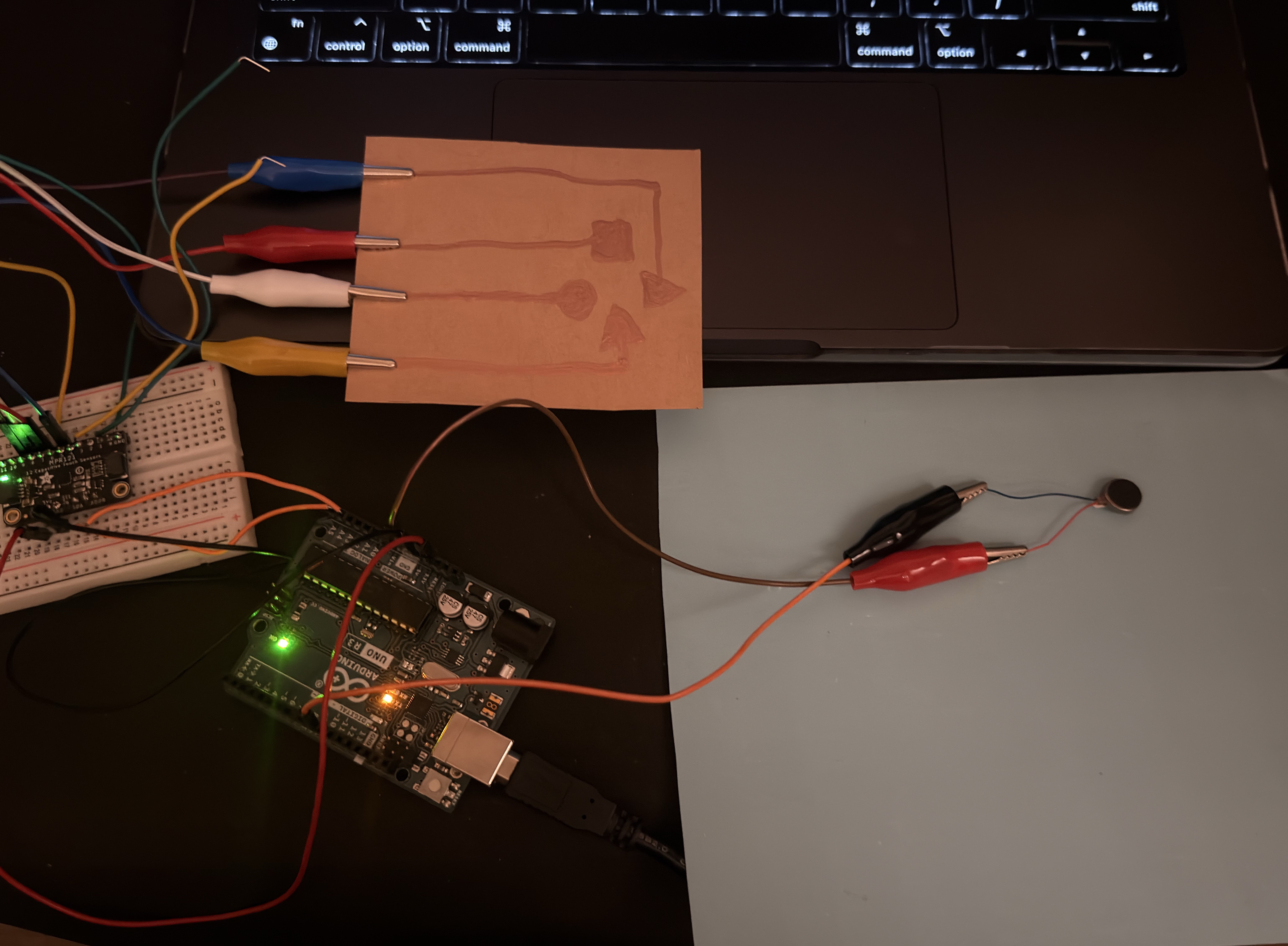
Connecting the Arduino, the vibration motor, and the touch sensor together became a lot more complicated than I thought it would be.
Every time I fixed one thing, something else would start glitching. The touch sensor was behaving inconsistently, and the wiring kept getting tangled to a point where I wasn’t sure what was happening anymore.
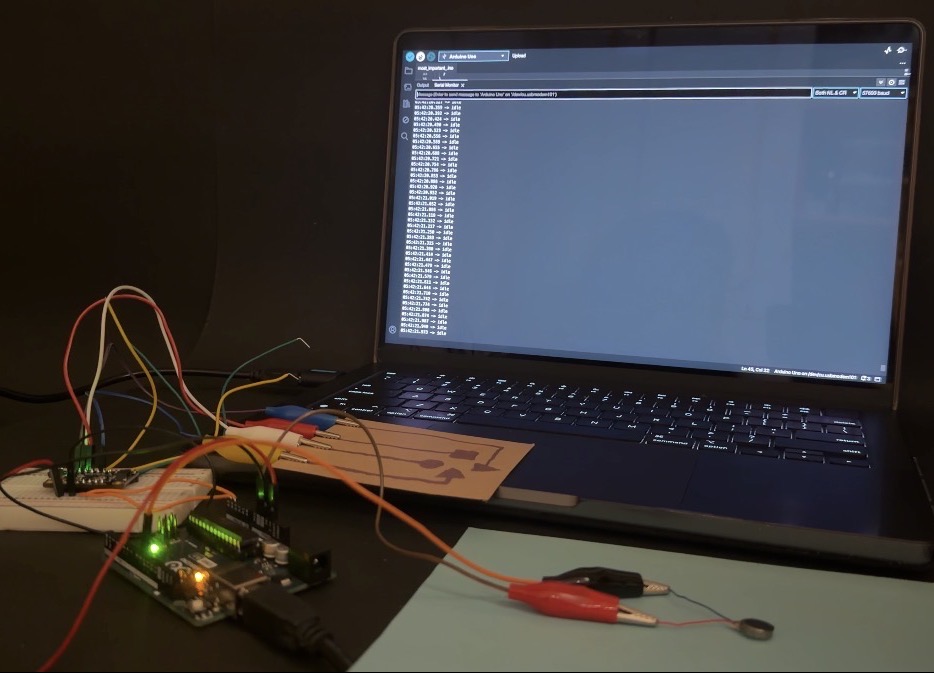
Because of all this, I couldn’t move on to the p5.js visuals. I tried multiple times to get the readings from Arduino into p5, but nothing was stable enough to build on. It was frustrating because I could see the idea
clearly in my head, but the technical side just wasn’t cooperating. I realised at some point that forcing it would make everything worse, so instead of trying
to create a perfect system at the last minute, I shifted my focus to making a basic version that still communicates the core idea.
In the end, I put together a simplified prototype that shows the concept: touching different shapes triggers sound and activates the vibration motor. Even though it doesn’t have the visuals
yet, it still carries the essence of what I want to do: a small multisensory loop that connects touch and vibration to sound. It made my direction clear enough
to communicate without pretending that everything magically worked.
Reflection
Reflection
This semester felt like a long stretch of figuring things out piece by piece, and most of that happened through actually making rather than planning.
I moved from feeling unsure about where to even begin to slowly understanding how sound and touch can talk to each other through sensors, code, and material choices.
There were weeks where nothing worked and weeks where small breakthroughs made everything feel worth it. Looking back, I can see that I’ve built a foundation, not just in prototypes,
but in how I think about multisensory interaction. I’m more comfortable working with uncertainty and definitely more patient with debugging.
Next semester as well as during the break, I want to focus on refining rather than rushing. I want to rebuild my prototypes in a cleaner,
more intentional way so I can finally explore the full sonic–haptic experience I’ve been aiming for. With the base understanding in place, I can push deeper
into timing, responsiveness, and how users physically interact with these systems. I also want to be more organised with my workflow and give myself enough buffer
time for debugging, especially when working across hardware and software. Most importantly, I want feel more confident next semester. For things to be less about “making it work,”
but more about shaping the interaction into something that feels complete, cohesive, and meaningful.