Haptics & Sound
A new week where I started working on a topic that I am not very familiar with yet, but I was determined to change that by the
end of this week. While I realised making was important at this stage, I also understood that I wouldn’t get anywhere if I just blindly
got into making, since I wouldn’t know what to look for, what to observe, or even what a successful experiment should feel like. Plus, at that
point I already had three sound experiments that I wasn’t amazingly happy with but was at least okay with, because they had helped me learn a lot.
They could be in my work as early-stage attempts, but I knew I wanted to shift into something more grounded.
So I started by making my new readings list. I kept it short and manageable, and even though there were a few books, I decided to skim
through random chapters from each because we were short on time. Instead of forcing myself to read everything linearly, I jumped between
sections that felt relevant: vibrations, perception, sensory systems, and anything that hinted at interaction. Then I
put my readings into my notes and tried to slowly understand what direction I could push myself towards.
Readings:
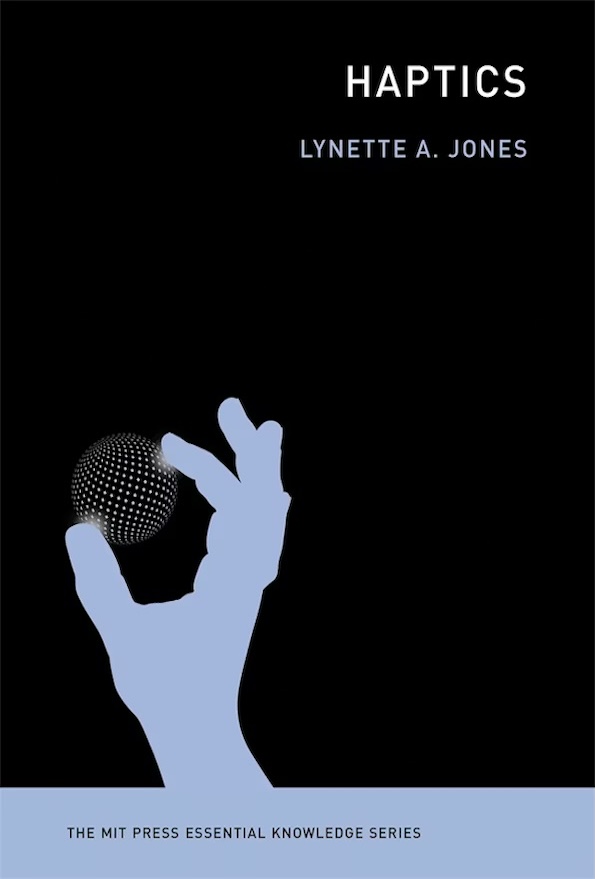
Haptics
By Lynette Jones
From this book I finally understood haptics as something that isn’t just “vibration,” but a whole sensory system with its own rules.
She talks about how the skin reads pressure, force, temperature, and movement, and how each of these creates different kinds of information.
It helped me see touch as something structured, not vague. After reading it, I could understand why certain interactions feel more immediate or more “real,”
and how the body compares sound and vibration without us thinking about it.
The Materiality of Interaction by Mikael Wiberg
This book made me think about interactions as physical experiences, not just screen-based or visual ones.
Wiberg talks about how materials shape the way we interact like their texture, weight, resistance, and the feedback they give.
It made me realise that digital systems also have a “material” quality, even if it’s invisible, and that haptics is basically the
bridge that lets the digital world feel tangible. It pushed me to think about how vibration, pressure and even tiny tactile cues can
become part of designing an experience, not just added on at the end.
I also read a few papers published as proceedings by CHI' conference adn featured the works of Hyunsung Cho, Sam Chin and more.
After reading not just books but also some very interesting papers on haptics, I was able to understand the entire concept way better and honestly found it really, really fascinating.
It felt like something I should’ve known about earlier or at least noticed more, but I had never bothered to. Haptics suddenly made sense as this huge area that sits right next to
sound. It is not separate, but operating on similar physical behaviours. After making my notes and understanding whatever I could, I finally decided on a focus for the next three weeks.
With haptics, vibration and pressure are two of the simplest things I could explore in the first stages or in the next two weeks because they are more straightforward. They give me something immediate to
observe like intensity, decay, direction, force. It also hit me that my experiment with the touch sensor already had pressure involved in it, and I could actually use that as a base point.
Instead of starting from scratch, I could extend what I had done and push that logic into something more intentional. I also decided to use piezo sensors for pressure since they are the most fun
to work with, and also very sensitive data providers. They respond to even tiny taps or bends, which makes them perfect for early haptic studies.
I realise that this week was a bit slow and did push me behind but I just wanted to have a clear head before I got started so nothing like the last time woul dhappen again. It was more important
for me to be sure of a direction this time since I was so close to a semester being over and had a lot to work on already.